
Dry Eye Treatment To Relief MGD (Meibomian Gland Dysfunction)
Dry Eye Treatment From TheraLife
TheraLife Eye capsules is an oral treatment that restores normal tear function to relief dry eyes – To reduce inflammation and help with MGD recovery. Maintain eye health to keep MGD at bay.
Meibomian Gland Dysfunction (MGD) is a common cause of dry eye. Dry Eyes can also cause MGD. Blockage of the meibomian glands can now be treated directly under local anesthesia using fine disposable probes called Intraductal Meibomian Gland Probing.
Best MGD/Blepharitis Treatment From TheraLife- When Drops Don’t Work.
How To Unclog the meibomian glands- Dry Eye Treatment
One of the major causes of chronic dry eye is blocked meibomian oil glands called Meibomian Gland Dysfunction (MGD). Research has indicated that 86% of the people with chronic dry eyes have MGD. With increasing awareness of this problem in recent years, we now have many approaches to treat this condition. Here are some of the examples:
- Hot compress – using heat to melt the clogging material and remove it.
- Debridement scaling – using an instrument to express ( squeeze) the clogging material out
- Instruments that heat the eyelid for ease of clogging removal
- Intraductal meibomian gland probing – the subject of discussion in this blog.
What Causes MGD?
Although dry eye is a complex, multifactorial disease, MGD is the most common cause of chronic dry eye diseases. The meibomian glands produce lubricants to thicken your tears; without it, your tear is too thin, which causes evaporative dry eyes. MGD is the physical obstruction of the meibomian gland duct and orifice. The lubricants now have reduced meibum or meibum that lacks sufficient qualitative properties to stabilize the tear film.
How do meibomian glands become clogged- Dry Eye Treatment
The causes of meibomian gland obstruction are interrelated to dry eyes.
Meibomian glands are sebaceous, and hormones control the lipid production of sebaceous glands throughout the body. When we age, our sex-steroid hormone levels also decrease, which causes the meibum to become thicker. At the same time, the production and secretion of lipids fall off. This is why post-menopausal women have dry eyes, and most of them have MGD.
Meibomian glands are related to hair follicles—they are also called “hair follicles without the shaft.” Meibomian glands retain a cellular commitment to keratinization ( new cells growing from the bottom while sluffing off old cells from the top). Typically, testosterone stops keratinization. Low androgen levels cause keratinization of the meibomian duct epithelium. Obstructive keratinization occurs at the orifice (opening). Gritty keratinized cellular debris can mix with the thickened meibum and plug the orifice. Once the gland is occluded, un-secreted meibum collects, causing elevated intraductal pressure, enlargement of the central glandular duct, and swollen and tender eyelids.
Are Dry Eyes and MGD Related
The critical culprit of MGD is inflammation, and dry eyes result in a high level of inflammation.
The processes of hyperkeratinization(which happens at a faster speed) can occur without inflammation. Inflammation may also play a role in MGD. Increased intraductal pressure can result in inflammation and diffuse scare tissues often seen on the autopsy of meibomian glands of post-menopausal women. Scare tissues of the gland and orifice may inhibit meibum secretion. Eyelid heating, massage, compression, lid cleaning, and physical expression of the glands are standard MGD treatment regimens. Heating decreases the viscosity of meibum, possibly melting some plugs and allowing freer flow. Heating might also increase meibum production. Lid scrubbing aims at opening blocked ductal orifices and keeping them open.
Warm compresses followed by lid massage helps mobilize the meibum. The physical expression of blocked glands has the goal of removing the obstruction and emptying the gland. Meibomian express may require little effort, but more than a bit of force is necessary and can cause pain.
How Can TheraLife Help?
Dry Eye Treatment
Use TheraLife Dry Eye Treatment to get rid of MGD. Consistent results that works.
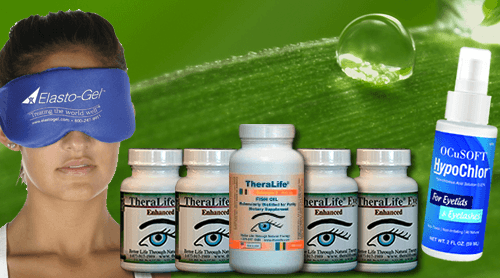
TheraLIfe Eye capsules reduce inflammation and restore normal tear functions. The meibomian glands will respond to the hot compress, fish oil, eyelid cleansing regimen much faster and better once inflammation is down. Read more about how TheraLife Eye works and how successful the TheraLife MGD protocol works.
Call and talk to a doctor- 11-877-917-1989 US/Canada. International (650) 949-6080: email to: [email protected]
Best MGD/Blepharitis Treatment From TheraLife- When Drops Don’t Work.
References
- 1. Nelson JD, Shimazaki J, Benitez-del-Castillo JM, Craig JP, McCulley JP, Den S, Foulks GN. The international workshop on meibomian gland dysfunction: report of the definition and classification subcommittee. Invest Ophthalmol Vis Sci. 2011 Mar;52(4):1930-7. [PMC free article] [PubMed]
- 2. Milner MS, Beckman KA, Luchs JI, Allen QB, Awdeh RM, Berdahl J, Boland TS, Buznego C, Gira JP, Goldberg DF, Goldman D, Goyal RK, Jackson MA, Katz J, Kim T, Majmudar PA, Malhotra RP, McDonald MB, Rajpal RK, Raviv T, Rowen S, Shamie N, Solomon JD, Stonecipher K, Tauber S, Trattler W, Walter KA, Waring GO, Weinstock RJ, Wiley WF, Yeu E. Dysfunctional tear syndrome: dry eye disease and associated tear film disorders – new strategies for diagnosis and treatment. Curr Opin Ophthalmol. 2017 Jan;27 Suppl 1(Suppl 1):3-47. [PMC free article] [PubMed]
- 3. Knop E, Knop N, Millar T, Obata H, Sullivan DA. The international workshop on meibomian gland dysfunction: report of the subcommittee on anatomy, physiology, and pathophysiology of the meibomian gland. Invest Ophthalmol Vis Sci. 2011 Mar;52(4):1938-78. [PMC free article] [PubMed]
- 4. Tomlinson A, Bron AJ, Korb DR, Amano S, Paugh JR, Pearce EI, Yee R, Yokoi N, Arita R, Dogru M. The international workshop on meibomian gland dysfunction: report of the diagnosis subcommittee. Invest Ophthalmol Vis Sci. 2011 Mar;52(4):2006-49. [PMC free article] [PubMed]
- 5. Chhadva P, Goldhardt R, Galor A. Meibomian Gland Disease: The Role of Gland Dysfunction in Dry Eye Disease. Ophthalmology. 2017 Nov;124(11S):S20-S26. [PMC free article] [PubMed]
- 6. Geerling G, Baudouin C, Aragona P, Rolando M, Boboridis KG, Benítez-Del-Castillo JM, Akova YA, Merayo-Lloves J, Labetoulle M, Steinhoff M, Messmer EM. Emerging strategies for the diagnosis and treatment of meibomian gland dysfunction: Proceedings of the OCEAN group meeting. Ocul Surf. 2017 Apr;15(2):179-192. [PubMed]
- 7. Putnam CM. Diagnosis and management of blepharitis: an optometrist’s perspective. Clin Optom (Auckl). 2016;8:71-78. [PMC free article] [PubMed]
- 8. Schaumberg DA, Nichols JJ, Papas EB, Tong L, Uchino M, Nichols KK. The international workshop on meibomian gland dysfunction: report of the subcommittee on the epidemiology of, and associated risk factors for, MGD. Invest Ophthalmol Vis Sci. 2011 Mar;52(4):1994-2005. [PMC free article] [PubMed]
- 9. Gurlevik U, Kemeriz F, Yasar E. The effect of isotretinoin on meibomian glands in eyes: a pilot study. Int Ophthalmol. 2022 Jul;42(7):2071-2078. [PubMed]
- 10. Huang J, Guo MX, Xiang DM, Yan LF, Yu Y, Han L, Wang JX, Lu XH. The association of demodex infestation with pediatric chalazia. BMC Ophthalmol. 2022 Mar 16;22(1):124. [PMC free article] [PubMed]
- 11. Lee WJ, Kim M, Lee SH, Chun YS, Kim KW. The varied influence of ocular Demodex infestation on dry eye disease and meibomian gland dysfunction across different age groups. Sci Rep. 2023 Sep 28;13(1):16324. [PMC free article] [PubMed]
- 12. Ding G, Tan Y, Zhang C, Zhang Y, Wang X. Analysis of Demodex infection rate and risk factors in patients with meibomian gland dysfunction. Int Ophthalmol. 2023 Mar;43(3):877-884. [PubMed]
- 13. Hassanzadeh S, Varmaghani M, Zarei-Ghanavati S, Heravian Shandiz J, Azimi Khorasani A. Global Prevalence of Meibomian Gland Dysfunction: A Systematic Review and Meta-Analysis. Ocul Immunol Inflamm. 2021 Jan 02;29(1):66-75. [PubMed]
- 14. Suzuki T. Inflamed Obstructive Meibomian Gland Dysfunction Causes Ocular Surface Inflammation. Invest Ophthalmol Vis Sci. 2018 Nov 01;59(14):DES94-DES101. [PubMed]
- 15. Messmer EM. The pathophysiology, diagnosis, and treatment of dry eye disease. Dtsch Arztebl Int. 2015 Jan 30;112(5):71-81; quiz 82. [PMC free article] [PubMed]
- 16. Gutgesell VJ, Stern GA, Hood CI. Histopathology of meibomian gland dysfunction. Am J Ophthalmol. 1982 Sep;94(3):383-7. [PubMed]
- 17. Obata H. Anatomy and histopathology of human meibomian gland. Cornea. 2002 Oct;21(7 Suppl):S70-4. [PubMed]
- 18. Efron N. Grading scales for contact lens complications. Ophthalmic Physiol Opt. 1998 Mar;18(2):182-6. [PubMed]
- 19. Paugh JR, Kwan J, Christensen M, Nguyen AL, Senchyna M, Meadows D. Development of a Meibomian Gland Dysfunction-Specific Symptom Questionnaire. Eye Contact Lens. 2018 Jan;44(1):6-14. [PubMed]
- 20. Okumura Y, Inomata T, Iwata N, Sung J, Fujimoto K, Fujio K, Midorikawa-Inomata A, Miura M, Akasaki Y, Murakami A. A Review of Dry Eye Questionnaires: Measuring Patient-Reported Outcomes and Health-Related Quality of Life. Diagnostics (Basel). 2020 Aug 05;10(8) [PMC free article] [PubMed]